But, can I tell you what’s different now compared to before? You’re allowed to speak up.
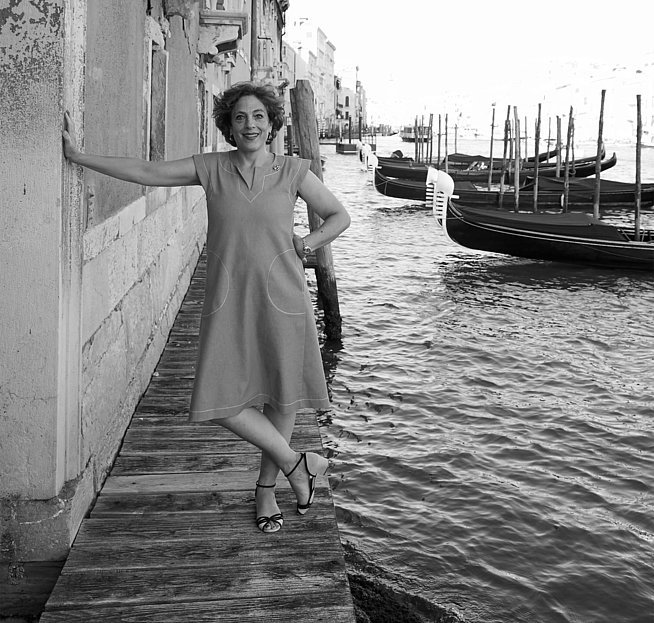
Jane da Mosto
Environmental activist and Founder of We Are Here Venice (WahV).
You can find more about her work here.
Q & A
Basic Questions:
1. What’s your name?
My name is Jane da Mosto.
2. Where are you from and where are you currently?
I was born in Johannesburg, South Africa. I grew up based in London, England. Since 1995, I've been living in Venice, Italy.
3. What do you do?
I'm the co-founder and executive director of ‘We Are Here Venice’ which is a new kind of research collective mixed with an activist platform. Basically, I work in many different ways to further the mission of ‘We Are Here Venice’ which is to protect the future of Venice as a living city.
4. Who is your biggest role model?
Maybe my cat.
Specific Questions:
1. Why and when did you start ‘We Are Here Venice’? Was there a specific event that led to an urge or realisation? Or was it more gradual? I know you studied the environment at the University of Oxford…
It was in steps. Before I moved to Venice, I worked in Milan for two years in an environmental economics think tank. Then, I moved here and worked in scientific research. At the same time, I was very aware of the limitations of research: it wasn’t being taken into consideration enough in the actual policymaking. The policymakers don't make much time to try and understand the science that's relevant to know what to do. But also on the scientists’ side, they're often very reluctant to take time out of their research work to actually explain things. Sometimes, I find that scientists, even on my team, get frustrated by needing to simplify things so other people understand the data. So, I think we need to collectively make an effort to find a framework to deal with the breadth of everything. We need to understand that it is only if we speak together, we would give a stronger message. Additionally, I think more needs to be done to let the communities have more of a say in what happens because you can’t just leave it to the institutions. I have worked closely with the Venice Biennale since 2010 to find a common ground between the art fair and the city itself. We ran workshops where people representing the international exhibitors were listening to what the Venetians were seeing and what the Venetians thought was relevant. Slowly, I realised that for Venice to be saved, there is a need for a strong local community for the actual application of change.
2. How accurately do you think the information on climate change is portrayed in popular media?
Well, I know we do our best to have to give accurate concise information when we're contacted by journalists. We learned very early on that since we're often quoted to provide explanations of this phenomenon, we give clear, correct information. But we can't do anything about the destructiveness of how people read. I mean, sometimes even my husband is guilty of not reading things properly or skimming. Then, you find yourself with information that doesn’t make sense out of context.
3. I think we can all acknowledge that Venice is a tourist hot spot. How is tourism affecting the environment?
Oh, really badly. Because mass tourism is so wasteful. It uses so much and thus produces lots of greenhouse gases. It’s one of the most environmentally impacting sectors of the economy. So, it's a real problem.
4. Do you think economic progress and environmental sustainability are in opposition with each other? A lot of people believe that and that's why they don't necessarily want to help the environment, even though they know it's morally right.
There is a lot to talk about here. Firstly, we're definitely living outside the capacity of the Earth. So, economic development, in terms of increasing the amount of production and consumption, just can’t fit within sustainability goals. This is why we need more systematic change as well as community-led change. We need to redefine what well-being is and realise that we can't just use economics and monetary terms to measure everything because, as you have said, we're going to run into a conflict between sustainability and growth.
5. How can education help to solve global warming? Is education enough or do we need more than that?
Education is very important because it's through education that you develop your own expectations and your own ambitions. But I think we need to broaden the idea of how to educate people. In South Africa, we had a farm and my father started this big school on the farm for the children of the workers. But even after many years of running the school, not many of the school children got beyond the middle school level. Later, there was transport provided for the kids to go to the nearest town for high school, but very few kids wanted to go to high school. So, my father started working more on educating the adults to create an environment in which the children could do their learning at home which became very effective. This is a good example of how traditional education may not be the best system for learning.
5. What was your dream as a child and what is your dream now? Has it changed?
I think that as a child, my dream was to stay a child. I had a very idyllic childhood. I had dogs, a cat, a tortoise, and cows that we would milk. But more than anything, I had a very active fantasy world. Now, one dream is to wake up and find that this kind of hellish world that we're living in, is the dream and I can not do what I'm currently doing. The other dream, and a more realistic one perhaps, is that my work leads to real change. I want Venice to go back to what it is capable of being.
6. Where do you see yourself and the environment in 20 years?
Oh, that's scary. It's too scary to think of because I wouldn't like to be on the current trajectory that we're on now. I think the pandemic and the war in Ukraine also make me think that we have to stop expecting humanity as a whole, to save itself, even though we shouldn't stop trying and hoping and doing what we can to make that happen.
7. Do you have hope that Venice can like go back to what it really was? Or do you think there's no reversal?
I think Venice can definitely change course. I don't think Venice needs to go back to people walking around in funny dresses with funny shoes and, you know, 18th-century costumes. But I think that Venice can return to a situation where the physical, social, environmental and ecological realms are much better balanced. And within that, I think that Venice can return to being more self-sufficient. For example, I would love for it to become carbon neutral or carbon negative.
6. It is widely acknowledged that change in the world should start with changes in yourself. What are ways you have personally changed for the environment and are there small things you recommend the listeners can change in their daily lives? I remember when we talked in Venice that you said that you avoid taking planes if possible…
Yeah, I don't want to prescribe anything but everybody needs to take responsibility for their own decisions. I’m not going to tell everybody to become vegan. I'm not vegan. Besides, there are studies to show that the intensive production of soya and other food frequent in a vegan diet is harmful to the environment. So, I think that people need to do as much as they can in their local context. You can’t apply one method to everyone. That’s not how it works.
7. You have a long list of partners including notable educational institutions such as the University of Cambridge as well as museums like the Peggy Guggenheim Collection. Personal change is important but in what ways can big corporate companies and institutions do to help the environment?
I learned a term the other day. It's called ‘transformative philanthropy’. By working with the Peggy Guggenheim Collection, we are given the opportunity to get the museum to place environmental issues on its own agenda in how and what they do. Then, our collaboration with the University of Cambridge is just really precious because we hear a lot about the research going on there and, through them, in other places in the world that's very relevant to what we're doing in the coastal zone.
8. What’s your opinion on performative activism and companies which use environmentalism and sustainability as a way of seeming “woke” or “moral” to generate more profit? How can we differentiate between people and institutions that are genuine or not? Does it matter what their intentions are as long as the outcome is beneficial?
Well, beneficial outcomes are always desirable but I think sometimes we need to be more vigilant about when the outcome is really beneficial and to who. For example, I went to a presentation of this really depressing book called ‘Venice, Final Act’. I wondered why he would essentially say Venice is doomed from the get-go. You know, of course, it's going to sell lots of copies. It's got a very catching cover and title. However, I thought that he could have also used the book launch as a platform for talking about real environmental solutions. It’s easy to be sensationalist but it’s important to be honest.
9. How do you feel especially as a woman trying to create change in the world? I understand that many business leaders and politicians you have to work with or convince are predominantly men. Do you think gender affects how you're perceived or treated? Often when women start a business organisation, they're often dismissed as passion projects or they're not taken as seriously.
It's true. We just deal with it on a case-by-case basis, like every single day. You just have to keep going. One of the challenges is for people to understand that ‘We Are Here Venice’ is going to concern everybody.
I don’t want to waste so much energy on clashes. But, can I tell you what’s different now compared to before? You’re allowed to speak up. 10 years ago, you couldn't really say what you were feeling. When I was working in Milan, I had a really big problem with this and I couldn't even say it was a problem. But now, you can actually say, “I'm feeling uncomfortable” or whatever and they’ll have to stop.